



Apatite: Meaning, Cleansing and Care
The KUSHA Atlas of stones
Apatite meaning, cleansing and care
A small cue for steadier habits
- Steadier habits
- Momentum
- From idea to action
- Chakras
- Solar Plexus, Throat and Third Eye
- Elements
- Air and Fire
- Planets
- Mars and Mercury
- Tier
- Steady
- Material
- Apatite
- Hardness
- 5 on the Mohs scale
- Sold as
- Natural
Meaning
Apatite meaning
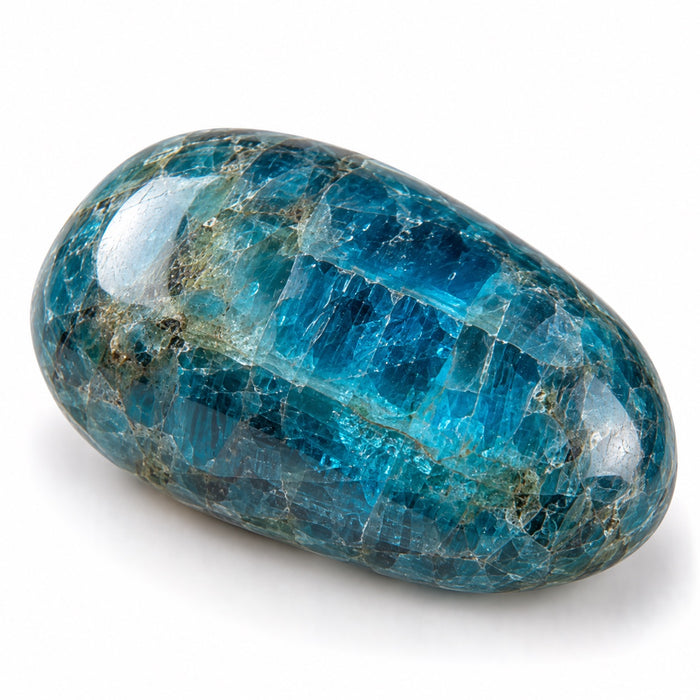
Apatite takes its name from the Greek apatē, deceit, because it was so often mistaken for other minerals, and it ranges from vivid blue to green and yellow. The KUSHA canon calls it the motivation stone and gives it a rare alignment across three centres: the Solar Plexus first, then the Throat and Third Eye, joining clear thinking to the will to act. Where citrine builds self-worth and carnelian desire, the canon sees apatite as the steady push from knowing what you want to doing it.
Posture matters in the canon’s ritual for apatite: the stone sits against the Solar Plexus, the spine lengthened, while a short line is spoken under the breath, “I begin and I continue.” Apatite is for the person with plenty of ideas and too little follow-through, or who feels capable but stalled. In the canon’s reading it stirs energy rather than restoring it, so the stone is rested when your reserves are low or everything already feels like too much.
We share these associations as tradition, not as a promise of results.
Care
How to cleanse and care for apatite
Best ways to cleanse it: Selenite plate · Smoke · Sound
| Method | Can it bear it? | In our practice |
|---|---|---|
| A brief rinse | BrieflyApatite is soft (Mohs 5); rinse briefly in cool water and dry it. | We skip itOur practice keeps apatite away from water. |
| A bed of salt | AvoidSalt draws in damp, and apatite is best kept dry. | We skip it |
| Morning sun | BrieflyApatite is sensitive to heat, and some colours fade in light. | Not usually |
| Moonlight | Yes | We skip itIn the KUSHA chakra system, Solar Plexus stones skip evening moonlight. |
| Smoke | Yes | We use it |
| Sound | Yes | We use it |
| A selenite plate | Yes | We use it |
We use it: named for this stone in our canon. Not usually: safe for the stone, but not a method we name for it. We skip it: our practice keeps it away.
Pairings
What apatite sits well with
From the KUSHA canon, the stones most often set beside it.
 Citrine
 Tiger’s Eye
 Fluorite
 Clear Quartz
A note of care
Before you use it
An activating stone: set it aside when you feel worn out or overwhelmed.
Real or fake
Is my apatite real?
We sell apatite as natural, and your lab certificate comes with your order.
- Blue apatite is most often imitated with blue glass, and some apatite is heated to improve its colour.
- Real apatite usually shows some natural cloudiness, small inner fractures and slight shifts of tone, while glass tends to look evenly coloured and either flawless or bubbly.
- True to its name, apatite can pass for other blue and green gems, so confirming exactly what it is takes a gemmologist.
Asked about apatite
Apatite, answered
Can apatite go in water?
Not in our practice. Our practice keeps apatite away from water. The stone itself takes a brief rinse.
Can apatite go in the sun?
It can. Apatite is sensitive to heat, and some colours fade in light. It is not one of the methods we name for apatite, so we do not usually use it.
Can apatite be cleansed on salt?
No. Salt draws in damp, and apatite is best kept dry.
How do you cleanse apatite?
In our practice, the best ways to cleanse apatite are a selenite plate, smoke and sound.
What does apatite mean?
Apatite takes its name from the Greek apatē, deceit, because it was so often mistaken for other minerals, and it ranges from vivid blue to green and yellow. The KUSHA canon calls it the motivation stone and gives it a rare alignment across three centres: the Solar Plexus first, then the Throat and Third Eye, joining clear thinking to the will to act. Where citrine builds self-worth and carnelian desire, the canon sees apatite as the steady push from knowing what you want to doing it.
Which chakra is apatite linked with?
Apatite is traditionally linked with the Solar Plexus, Throat and Third Eye chakras. In the KUSHA system, its elements are air and fire and its planets are Mars and Mercury. We share these associations as tradition, not as a promise of results.
What does apatite pair well with?
In the KUSHA system, apatite sits well with citrine, tiger’s eye, fluorite and clear quartz.
Is apatite good for beginners?
Yes, with a little attention. Apatite is a steady stone, easy to live with. An activating stone: set it aside when you feel worn out or overwhelmed.
Still asking?
Ask the Atlas, or ask a person.
Written by the KUSHA Studio, Jaipur. Last updated 15 October 2026. Crystal associations come from tradition and our own practice, and Pranic Healing is a complementary practice. Nothing here is medical advice. Our products and services are not intended to diagnose, treat, cure or prevent any medical or psychological condition, and no outcome is promised. Please see a qualified professional about any health concern. Healing disclaimer