Article: Crystals Are Older Than Belief - And That Matters
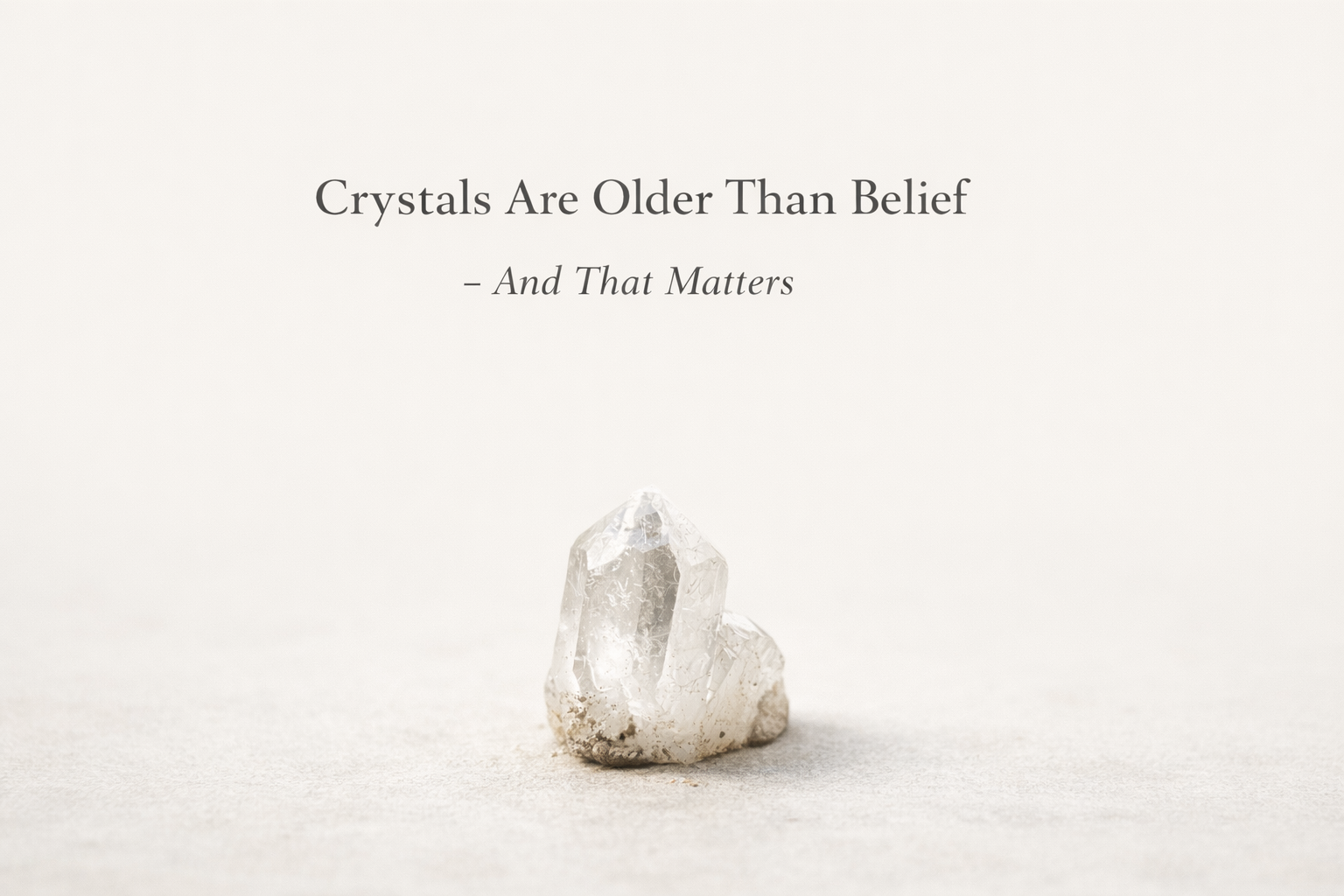
Crystals Are Older Than Belief - And That Matters
Crystals existed long before language learned how to name them, before belief systems tried to
explain them, and long before humans decided they could be “used.” They formed under
pressure, heat, time, and conditions that are difficult for the modern mind to fully comprehend.
Some took millions of years to settle into the structures we now hold in our hands.
This matters more than we usually acknowledge.
Today, crystals are often spoken about emotionally — how they make us feel, what they “do,”
what they attract or remove. But that framing is recent. It belongs to human interpretation, not
to the crystals themselves. A crystal does not respond to belief. It does not adjust its structure
based on expectation. It simply exists as it always has: stable, ordered, consistent.
And that stability is precisely why humans respond to them.
Crystals are not emotional tools.
They are structural ones.
Their internal lattice — the precise, repeating arrangement of atoms — is what makes them
unique. This internal order does not fluctuate. It does not get anxious. It does not rush. When
humans come into contact with something that stable, the nervous system notices, even if the
mind doesn’t.
In Pranic understanding, the human energy body is far more sensitive than the thinking mind. It
constantly responds to rhythm, coherence, and disturbance. When someone is emotionally
overwhelmed, mentally scattered, or energetically depleted, their system lacks order. Not in a
dramatic way — but in small, accumulating ways that show up as restlessness, irritability, or
fatigue without a clear cause.
A crystal does not “heal” this.
It does something quieter.
It offers a reference point.
Because crystals hold their structure without effort, the human energy field can subtly entrain to
that steadiness. This is not mystical. It is regulatory. Much like how the body calms down in
nature — not because trees are trying to help, but because their presence is stable and
non-demanding.
This is why people often struggle to explain what crystals do. They expect an emotional
experience. What they receive instead is often a reduction in noise.
The problem begins when crystals are treated as emotional agents rather than energetic
anchors. When they are assigned tasks — attract this, remove that, fix this part of life — they
are no longer respected for what they are. They are turned into symbolic objects, and
symbolism always fluctuates with belief.
But crystals don’t fluctuate.
They don’t respond to desperation.
They don’t accelerate because someone wants faster results.
They don’t amplify emotion unless the system interacting with them is already unstable.
This is also why some people feel overwhelmed by crystals. Not because the stone is “too
strong,” but because their system isn’t used to sustained coherence. When internal chaos
meets external order, the contrast can feel uncomfortable at first.
Stillness can be confronting.
Another misconception is that crystals work because they are rare or beautiful. In reality, their
visual appeal is secondary. What matters is how intact their structure is, how they were
sourced, how they were handled, and whether their natural stability has been disturbed through
excessive cutting, chemical treatment, or careless energization.
A crystal that has been aggressively altered may still look impressive, but its energetic
coherence can be compromised. It may feel inconsistent, sharp, or tiring to be around — not
because it is “bad,” but because its internal order has been disrupted.
This is why origin matters.
Where a crystal comes from, how it formed, and how it was extracted all influence how stable it
remains. Crystals formed slowly under balanced conditions tend to feel grounding. Those
formed under extreme or rushed conditions often feel intense or erratic.
Again, these are not moral qualities.
They are structural ones.
When people say a crystal “feels right,” what they are often responding to is compatibility — not
magic. Their system recognizes a frequency of order it can integrate with.
This is also why crystals are not for everyone, and not for every phase. During times of high
emotional sensitivity, even a stable crystal can feel too present. During times of numbness or
depletion, the same crystal can feel supportive. The object does not change. The human
system does.
Understanding this shifts how crystals are chosen and used.
They are no longer solutions.
They are companions.
They are not meant to replace inner work.
They are meant to hold space while inner work unfolds.
When crystals are treated with restraint — not constantly cleansed, charged, handled, or
assigned expectations — they do what they do best: remain steady. And that steadiness, over
time, has a quiet influence.
People often notice this influence only in retrospect. They realize they reacted less. That their
space felt calmer. That their thoughts didn’t spiral the way they used to. These are not dramatic
changes, and that is precisely the point.
Crystals are older than belief.
They do not participate in urgency.
In a world that constantly demands faster outcomes, louder manifestations, and visible proof,
crystals remind us of something deeply unfashionable: that stability takes time, and that real
alignment is rarely immediate.
Perhaps this is why humans keep returning to them across cultures and centuries. Not because
they promise anything — but because they don’t.
They simply remain.
And sometimes, that is exactly what the human system needs to remember how to do.