


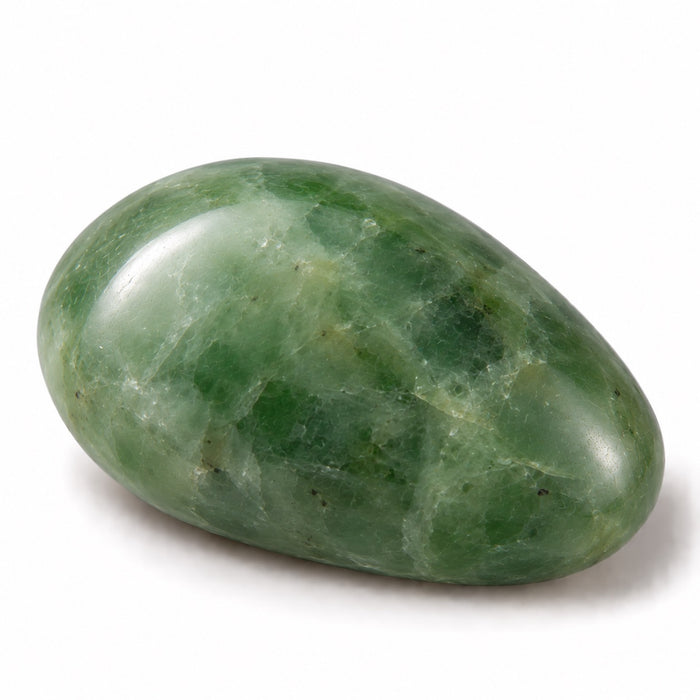
Jade: Meaning, Cleansing and Care
The KUSHA Atlas of stones
Jade meaning, cleansing and care
Cool green, for patience and steady growth
- Balance, not highs and lows
- Patience and steady growth
- Harmony at home
- Chakras
- Heart and Solar Plexus
- Element
- Earth
- Planets
- Venus and Mercury
- Energy
- Neutral
- Tier
- Gentle
- Material
- Jade (nephrite or jadeite)
- Hardness
- 6 to 7 on the Mohs scale
- Sold as
- Ask us
Meaning
Jade meaning
Jade is a name shared by two different minerals: nephrite, a tough mat of interlocking fibres, and jadeite, a rarer stone of tightly knit grains, first told apart by the French mineralogist Alexis Damour in 1863. Both have been carved and treasured for thousands of years, nephrite above all in China. To the KUSHA canon, jade is an emotional harmoniser, cool, firm and dependable, at home in the Heart and steadied by the Solar Plexus: a stone for an even keel rather than peaks and dips.
We use it in a simple breathing ritual: jade over the heart, an inhale counted to four, and the phrase “I return to balance.” Jade suits people who want steadiness without intensity, and who would rather have a calm, even companion than a dramatic one. Because the canon sees jade as holding things still rather than opening them, it suggests another stone for deep emotional work, or on days when feeling has gone numb and needs to move again.
We share these associations as tradition, not as a promise of results.
Care
How to cleanse and care for jade
Best ways to cleanse it: Selenite plate · Moonlight · Smoke
| Method | Can it bear it? | In our practice |
|---|---|---|
| A brief rinse | BrieflyJade is very tough; a quick rinse is fine, then dry it. | We use it |
| A bed of salt | Yes | We skip itOur practice keeps jade off salt. |
| Morning sun | Yes | We skip itOur practice keeps jade out of the sun. |
| Moonlight | YesBy a window, for three to five hours only. | We use it |
| Smoke | Yes | We use it |
| Sound | Yes | We skip itOur practice keeps emotional stones to moonlight and breath, plus the few methods named for each stone. |
| A selenite plate | Yes | We use it |
We use it: named for this stone in our canon. Not usually: safe for the stone, but not a method we name for it. We skip it: our practice keeps it away.
Pairings
What jade sits well with
From the KUSHA canon, the stones most often set beside it.
 Green Aventurine
 Rhodonite
 Clear Quartz
A note of care
Before you use it
A steadying stone: in a numb season, or during deep heart work, a more opening heart stone may suit you better.
Real or fake
Is my jade real?
Jade is two minerals, nephrite and jadeite, and the trade also sells dyed stones and look-alikes under the name. Ask us what the piece you are choosing is before you buy; your lab certificate comes with your order.
- Much that is sold as jade is something else: serpentine, green aventurine, dyed quartz or glass, often under trade names such as “new jade” or “Malaysia jade”.
- Jadeite is also bleached and filled with resin, or dyed, to brighten weaker material.
- True jade feels cool and surprisingly heavy for its size, with a slightly waxy polish, and under a loupe glass gives itself away with round bubbles.
- Very bright, perfectly even green at a modest price is the clearest warning.
Asked about jade
Jade, answered
Can jade go in water?
Yes. Jade is very tough; a quick rinse is fine, then dry it. A few seconds under running water, then dry it well. We use it in our practice.
Can jade go in the sun?
Not in our practice. Our practice keeps jade out of the sun. Sunlight would not harm the stone itself.
Can jade be cleansed on salt?
Not in our practice. Our practice keeps jade off salt. Dry salt would not harm the stone itself.
How do you cleanse jade?
In our practice, the best ways to cleanse jade are a selenite plate, moonlight and smoke.
What does jade mean?
Jade is a name shared by two different minerals: nephrite, a tough mat of interlocking fibres, and jadeite, a rarer stone of tightly knit grains, first told apart by the French mineralogist Alexis Damour in 1863. Both have been carved and treasured for thousands of years, nephrite above all in China. To the KUSHA canon, jade is an emotional harmoniser, cool, firm and dependable, at home in the Heart and steadied by the Solar Plexus: a stone for an even keel rather than peaks and dips.
Which chakra is jade linked with?
Jade is traditionally linked with the Heart and Solar Plexus chakras. In the KUSHA system, its element is earth and its planets are Venus and Mercury. We share these associations as tradition, not as a promise of results.
What does jade pair well with?
In the KUSHA system, jade sits well with green aventurine, rhodonite and clear quartz.
Is jade good for beginners?
Yes. Jade is a gentle stone, good to begin with. A steadying stone: in a numb season, or during deep heart work, a more opening heart stone may suit you better.
Still asking?
Ask the Atlas, or ask a person.
Written by the KUSHA Studio, Jaipur. Last updated 15 October 2026. Crystal associations come from tradition and our own practice, and Pranic Healing is a complementary practice. Nothing here is medical advice. Our products and services are not intended to diagnose, treat, cure or prevent any medical or psychological condition, and no outcome is promised. Please see a qualified professional about any health concern. Healing disclaimer