



Kunzite: Meaning, Cleansing and Care

The KUSHA Atlas of stones
Kunzite meaning, cleansing and care
Gentleness in soft pink and lilac
- Gentleness
- Letting love in
- Deeper closeness
- Chakras
- Heart and Crown
- Element
- Air
- Planets
- Venus and Neptune
- Energy
- Softly cool
- Tier
- Strong
- Material
- Spodumene
- Hardness
- 6.5 to 7 on the Mohs scale
- Sold as
- Natural
Meaning
Kunzite meaning
Kunzite is spodumene in soft pink to lilac, named after the American gemmologist George F. Kunz. Among the high-frequency stones of the KUSHA canon, meaning those felt as bright and expansive rather than settling, it is set at the Heart and Crown. Where gentler pink stones soothe, the canon sees kunzite as opening: it is associated with compassion, emotional honesty and a love that reaches beyond the self, and it asks for readiness rather than offering comfort.
In our practice its ritual is brief: kunzite is cradled at the Heart while the breath rises gently upward, and a few quiet words of intention are spoken. Kunzite asks for a settled inner practice and a readiness to soften old reserve, with amethyst as its calming partner in the canon. In a season of loss or fresh heartbreak, or whenever you feel brittle and emotions already run high, the canon advises a softer stone, since kunzite may ask more than a tender moment can give.
We share these associations as tradition, not as a promise of results.
Care
How to cleanse and care for kunzite
Best ways to cleanse it: Moonlight · Smoke · Selenite plate
| Method | Can it bear it? | In our practice |
|---|---|---|
| A brief rinse | BrieflyGIA recommends lukewarm soapy water; avoid steam and ultrasonic cleaners. | We skip itOur practice keeps kunzite away from water. |
| A bed of salt | Yes | We skip itIn the KUSHA system, high-frequency stones are kept off salt. |
| Morning sun | AvoidKunzite’s pink fades quickly in sunlight. | We skip it |
| Moonlight | YesBy a window, for three to five hours only. | We use it |
| Smoke | Yes | We use it |
| Sound | Yes | Not usually |
| A selenite plate | Yes | We use it |
We use it: named for this stone in our canon. Not usually: safe for the stone, but not a method we name for it. We skip it: our practice keeps it away.
Pairings
What kunzite sits well with
From the KUSHA canon, the stones most often set beside it.
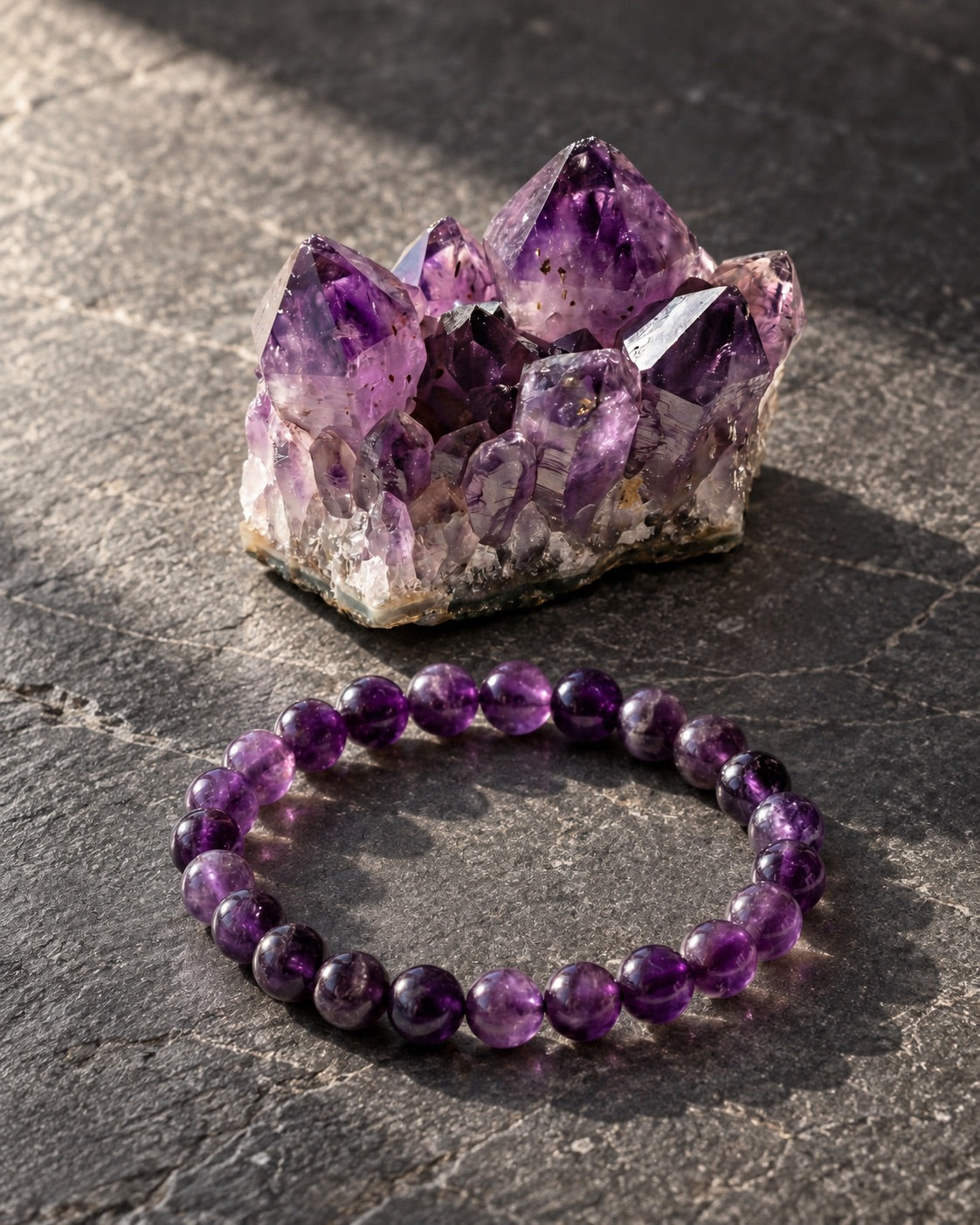
 Amethyst
Kept apart from rose quartz. KUSHA pairing law 1 keeps rose quartz and kunzite apart: together they can feel like too much for the heart.
Kept apart from moldavite. The KUSHA canon never pairs moldavite with a Crown stone: together they can open too much at once.
A note of care
Before you use it
A high-frequency stone for steady seasons only: set it aside if you are anxious, grieving, newly heartbroken or feeling fragile.
Real or fake
Is my kunzite real?
We sell kunzite as natural, and your lab certificate comes with your order.
- Kunzite looks most strongly coloured when viewed down the length of the crystal and paler from the side, a shift that pink glass cannot copy.
- Under a 10x loupe natural pieces often carry fine lengthwise lines or slender tube-like inclusions, while glass may show gas bubbles and feels less cold to the touch.
- Some kunzite is irradiated or heated to deepen its pink, and that colour, like the natural one, can fade in strong light.
Asked about kunzite
Kunzite, answered
Can kunzite go in water?
Not in our practice. Our practice keeps kunzite away from water. The stone itself takes a brief rinse.
Can kunzite go in the sun?
No. Kunzite’s pink fades quickly in sunlight.
Can kunzite be cleansed on salt?
Not in our practice. In the KUSHA system, high-frequency stones are kept off salt. Dry salt would not harm the stone itself.
How do you cleanse kunzite?
In our practice, the best ways to cleanse kunzite are moonlight, smoke and a selenite plate.
What does kunzite mean?
Kunzite is spodumene in soft pink to lilac, named after the American gemmologist George F. Kunz. Among the high-frequency stones of the KUSHA canon, meaning those felt as bright and expansive rather than settling, it is set at the Heart and Crown. Where gentler pink stones soothe, the canon sees kunzite as opening: it is associated with compassion, emotional honesty and a love that reaches beyond the self, and it asks for readiness rather than offering comfort.
Which chakra is kunzite linked with?
Kunzite is traditionally linked with the Heart and Crown chakras. In the KUSHA system, its element is air and its planets are Venus and Neptune. We share these associations as tradition, not as a promise of results.
What does kunzite pair well with?
In the KUSHA system, kunzite sits well with amethyst. We keep it apart from rose quartz. KUSHA pairing law 1 keeps rose quartz and kunzite apart: together they can feel like too much for the heart. We keep it apart from moldavite. The KUSHA canon never pairs moldavite with a Crown stone: together they can open too much at once.
Is kunzite good for beginners?
Take it slowly. Kunzite is a strong stone: begin with short wear. A high-frequency stone for steady seasons only: set it aside if you are anxious, grieving, newly heartbroken or feeling fragile.
Still asking?
Ask the Atlas, or ask a person.
Written by the KUSHA Studio, Jaipur. Last updated 15 October 2026. Crystal associations come from tradition and our own practice, and Pranic Healing is a complementary practice. Nothing here is medical advice. Our products and services are not intended to diagnose, treat, cure or prevent any medical or psychological condition, and no outcome is promised. Please see a qualified professional about any health concern. Healing disclaimer